Skip to content

Introduction
Arc spraying, also known as twin-wire arc spraying, is one of the oldest and most widely used thermal spray technologies. Its origins date back to the early 20th century, and it remains a cost-effective solution for producing high-quality metallic coatings across numerous industries. This article covers the core principles, main types, key applications, and market outlook of arc spraying equipment.
What Is Arc Spraying?
Arc spraying uses an electric arc generated between two consumable wire electrodes to melt the coating material. Compressed air then atomizes and propels the molten particles onto the substrate, forming a dense metallic coating.
Compared to other thermal spray methods, arc spraying offers several distinct advantages: high deposition rates (up to 10–30 kg/h), excellent coating adhesion, low operating costs, and no hazardous radiation or high voltage risks. These features make it a preferred choice for large-area coating applications where productivity and cost-efficiency are paramount.
Core Working Principle
The heart of arc spraying equipment is the arc gun, which consists of two continuously fed wire electrodes. A typical system operates as follows:
- Wire feeding – Two wires of the coating material are fed independently into the gun at controlled speeds.
- Arc generation – A DC power supply creates an electric arc between the wire tips, melting them at temperatures up to 4000°C.
- Atomization and propulsion – Compressed air (or other gases) is directed across the arc zone, atomizing the molten metal and accelerating it toward the substrate.
- Coating formation – The molten particles impact the prepared surface, flattening and solidifying to form a dense, bonded coating.
This continuous process allows for high deposition rates and the ability to coat large surface areas quickly.
Main Types of Arc Spraying Equipment
Arc spraying systems are classified primarily by their power supply design and automation level:
By Power Source
- DC motor-driven systems – Use traditional DC power supplies with motorized wire feeders. Reliable and widely used in general industrial applications.
- Inverter-based systems – Modern systems using IGBT inverter technology. Offer better energy efficiency, precise current control, and lighter weight.
By Automation Level
- Handheld systems – Manual guns operated by skilled technicians. Suitable for field repair, small-batch production, and hard-to-reach areas.
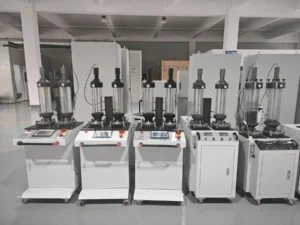
- Automated systems – Integrated with robotic manipulators, turntables, or CNC positioning systems. Ideal for high-volume manufacturing and applications requiring consistent, repeatable coating quality.
By Wire Configuration
- Twin-wire systems – Two wires of the same material, the most common configuration.
- Multi-wire systems – Allows simultaneous spraying of different materials or alloy combinations.
Key Components of Arc Spraying Equipment
A complete arc spraying system consists of several essential components:
- Arc spray gun – The core device where melting and atomization occur.
- Power supply – Typically 200–600 A DC, providing the electrical energy for arc generation.
- Wire feeder – Controls the feed rate of the two wires, typically 1–10 m/min.
- Compressed air system – Provides atomizing and propellant gas at 5–7 bar pressure.
- Control console – PLC-based controller with HMI interface for monitoring voltage, current, and wire speed.
- Auxiliary equipment – Includes ventilation systems, dust collectors, and workpiece manipulators.
Key Applications
Arc spraying is widely used across industries due to its versatility and cost-effectiveness:
- Corrosion protection – Zinc and aluminum coatings for steel structures, bridges, offshore platforms, and ships.
- Wear-resistant coatings – Applied to industrial rollers, pump shafts, and hydraulic cylinders.
- Electrical applications – Conductive coatings for grounding and electromagnetic shielding.
- Food and chemical industries – Corrosion-resistant coatings for processing equipment.
- Repair and remanufacturing – Restoring worn parts to original dimensions at low cost.
Market Trends
The global arc spraying equipment market continues to grow, driven by:
- Infrastructure investment – Growing demand for corrosion protection in bridges, pipelines, and offshore structures.
- Environmental regulations – Arc spraying offers a cleaner alternative to hazardous coatings like lead-based paints or cadmium plating.
- Increasing automation – Adoption of robotic arc spraying cells in automotive and aerospace manufacturing.
- Material innovations – Development of new wire alloys for advanced coating properties.
- Emerging markets – Rapid industrialization in Asia-Pacific and Latin America.
Future trends include smart systems with real-time monitoring, improved energy efficiency, and integration with Industry 4.0 frameworks.
Advantages Over Other Spraying Methods
| Feature | Arc Spraying | Plasma Spraying | HVOF |
|---|---|---|---|
| Equipment cost | Low | High | High |
| Operating cost | Low | Medium | High |
| Deposition rate | High | Medium | Low |
| Coating porosity | Medium (2–10%) | Low (<2%) | Very low (<1%) |
| Heat input | Low | High | Medium |
| Suitable materials | Conducting metals | Most materials | Carbides, metals |
Arc spraying’s key advantages are low cost, high productivity, and minimal heat-affected zones—making it ideal for large structures and thick coatings.
Conclusion
Arc spraying remains a cornerstone of the thermal spray industry. After more than a century of development, the technology has evolved from basic handheld systems to sophisticated automated cells capable of high-volume industrial production. With its unique balance of cost, speed, and coating quality, arc spraying continues to offer reliable solutions for corrosion protection, surface repair, and functional coating applications. Understanding its principles, equipment options, and application range helps industry professionals make informed decisions in an increasingly competitive market.